Free Tapas In Granada: What Comes With Your Drink And What Doesn't
In Granada a small plate of food still arrives with the drink you pay for in many bars. This guide sets out how the custom works, what it costs, where it is strongest, and how to build a cheap evening around it.
In Short
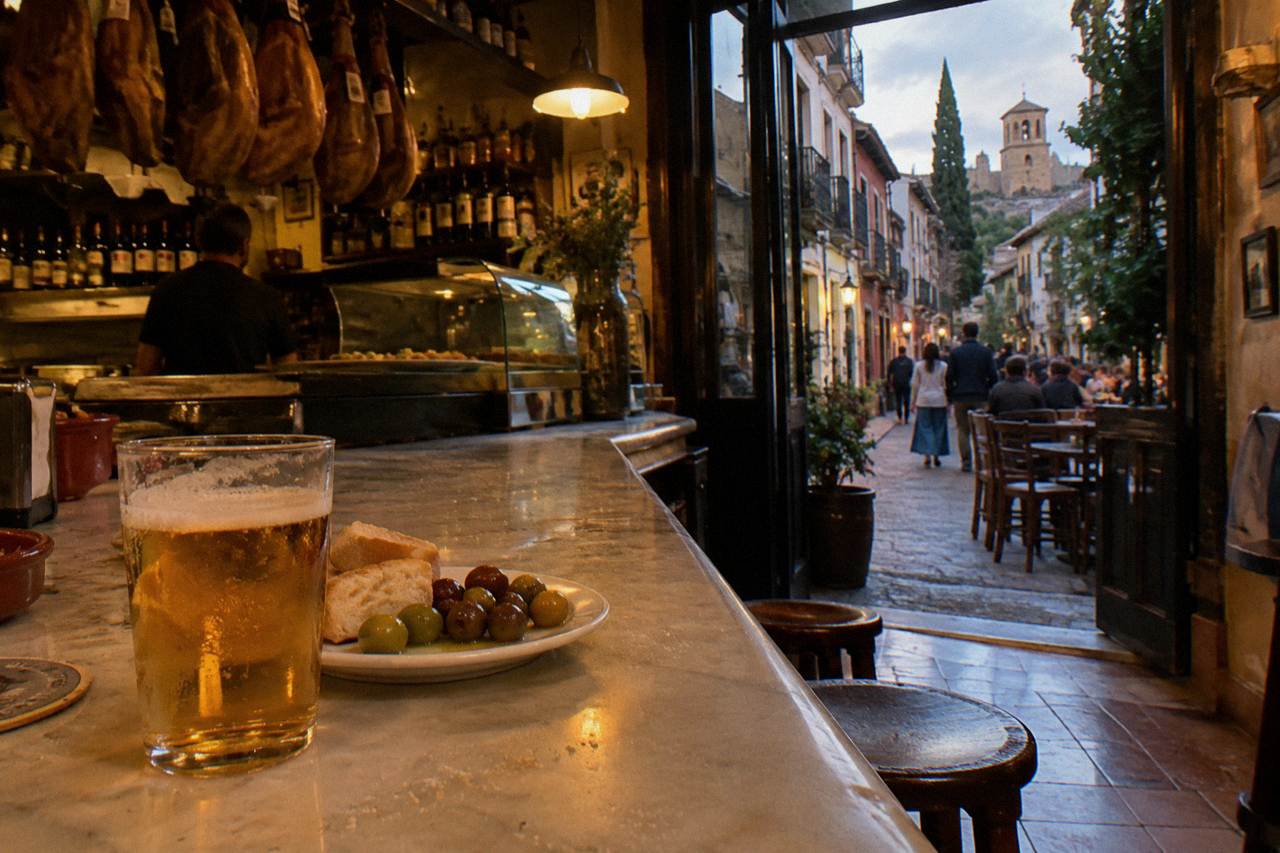
Tapas in Granada are not free in the sense of costing nothing: the custom is that a small dish comes with a drink you pay for, and it varies by bar. The drink costs money, the plate does not. The habit is strongest around Calle Navas, Calle Elvira, the Realejo and the Albaicín, and no official rule guarantees it anywhere.
Part of the Free Things To Do In Granada guides.
Quick Facts
| Question | Answer |
|---|---|
| Is the tapa itself free? | In bars that keep the custom, yes: the small dish arrives with a drink you order and pay for |
| What do you pay for? | The drink, every time; the tapa is not sold separately |
| Is it guaranteed? | No, it is a bar custom that varies from bar to bar, not a rule |
| Where is the custom strongest? | Calle Navas, Calle Elvira, the Realejo around Campo del Príncipe, and the Albaicín |
| Does water count? | The custom is described around beer, wine and soft drinks, not tap water |
| Can you sightsee on the same budget? | Yes, the miradores, plazas and tapas streets of the centre are free to be in |
| Nearest free walk platform | GuruWalk and freetour.com both list free, pay what you want walks meeting in the centre |
Is Tapas In Granada Really Free?
The honest answer is that the tapa is free and the drink is not. In Granada, in many bars, a small plate of food arrives with the drink you order and pay for, and nobody charges for the plate itself. It is a custom rather than a law: bars keep it voluntarily, it varies from bar to bar, and no official rule obliges any bar to serve one.
That single distinction is the whole subject, and it is worth getting straight before anything else, because the phrase "free tapas" does a lot of sloppy work in travel writing. Nothing in Granada is free in the way a public square is free. The tapa travels with the drink. You pay for a beer, a glass of wine or a soft drink, and the bar sets down a small dish beside it: olives, a wedge of tortilla, a spoonful of stew, whatever the kitchen sends out. The drink appears on the bill. The plate does not.
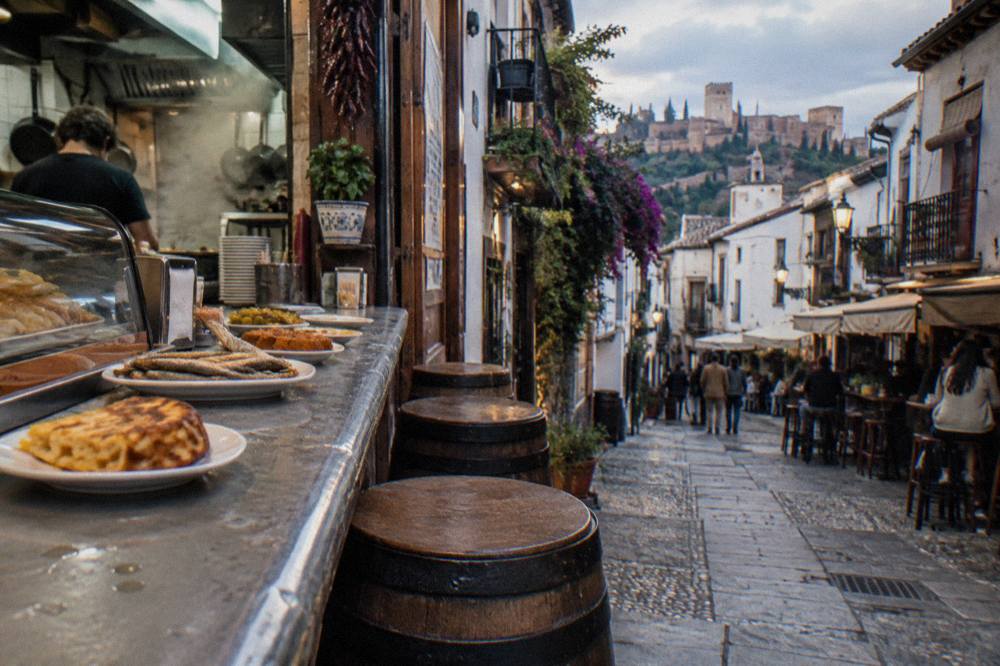
The custom varies by bar, and that variation is the second thing to hold on to. Some bars bring a different tapa with each round of drinks, moving through a sequence as the evening goes on. Some bring the same dish every time. Some bring nothing at all and were never part of the tradition. There is no register of which bars do what, no plaque on the door, and no way to know from the outside. The city's own tourism body describes the practice as generally offered, which is about as far as an honest sentence can go.
What can be said with confidence is where the habit runs deepest. Calle Navas, the short street of bare-bones tabernas just off Puerta Real, is the classic tapas street. Calle Elvira, climbing from Gran Vía toward the Albaicín, is the other big one. In the Realejo, the bars around Campo del Príncipe keep the custom, and up in the Albaicín plenty of neighbourhood tavernas do too. The city tourism office keeps a free-entry overview of the city's free side on its site, turismo.granada.org's free entry page, which frames the custom the same careful way.
Why does Granada do this when almost nowhere else in Spain reliably does? The honest answer is that nobody has a verified explanation, and this site will not invent one. Counters of legend and folklore exist on every free-walk route in the city, but a legend told on a plaza is not a source. What is verifiable is narrower: the custom persists in 2026, press coverage through the year continues to describe it as generally offered, and the drink remains the thing you pay for.
What Does The Free Tapa Actually Come With?
The tapa comes with a paid drink: beer, wine or a soft drink, ordered at the bar or table. It does not come with tap water, it is not served on its own, and it is not a discount applied to food you order from the menu. If you order a full plate from the menu, you pay for the full plate; the free dish only ever arrives alongside a drink you have bought.
That is the mechanism, and it is worth spelling out because visitors regularly misread it in both directions. Some expect a plate of food for walking in, which never happens. Others assume the custom caps what a bar can charge, which is also wrong. The bar sets its drink prices freely; the tapa is the bar's own gesture on top. The practical consequence is that the price of your evening is set almost entirely by drink prices and how many rounds you have, not by the food.
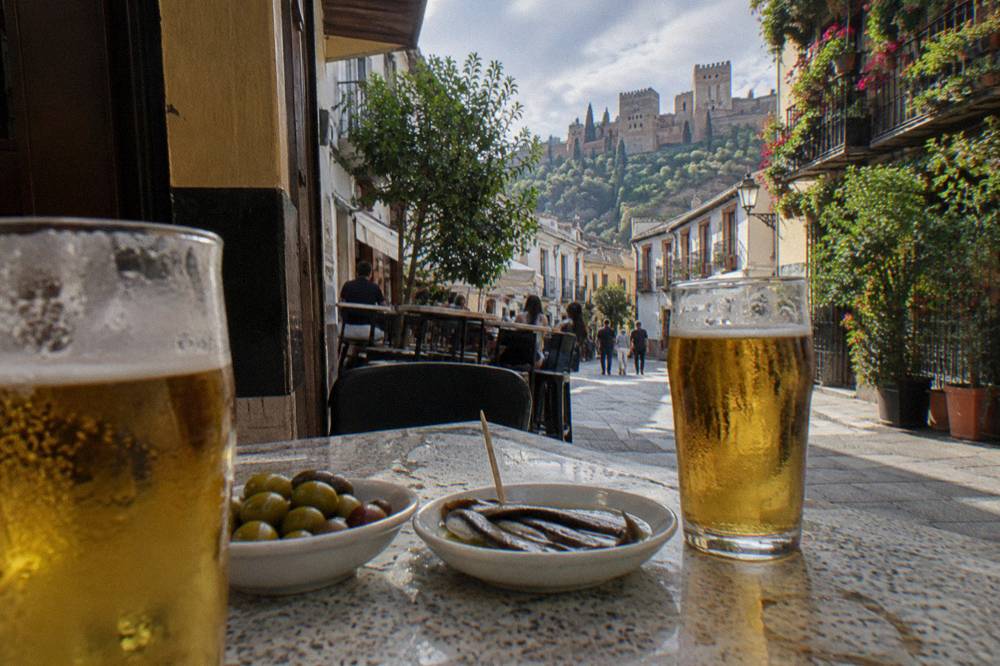
The dishes themselves are the bar's choice, and that is part of the pleasure of the custom. In the traditional tabernas of Calle Navas you are as likely to get something humble, a dish of olives, a slice of bread with something on it, as something cooked. Elsewhere the kitchen decides and the diner does not. There is no ordering from the free kitchen, no substitutions, and no guarantee the next round brings something different, though in bars that run a sequence it usually does.
For anyone comparing Granada's free side generally, the same discipline applies everywhere: a mirador is free to stand on, the Alhambra monument costs about EUR 22, and a tapa is free only in the company of a paid drink. This site exists to keep those regimes separate, and the fuller picture is on Free Things To Do In Granada. The tapas custom is the most easily misunderstood item on the list precisely because it looks, from the outside, like something for nothing.
A free walking tour slots into a tapas evening better than almost any other paid or free activity, because the walks finish in the early evening in exactly the districts where the custom lives. The walks above run on GuruWalk and freetour.com as free, pay what you want tours by independent local guides; this site operates none of them, and its links to both platforms carry its referral code. You reserve a spot, walk, and tip the guide what you think the walk was worth.
What Costs Money When You Order Tapas?
Only the drinks and anything you order from the menu costs money. The tapa itself never appears on the bill in a bar that keeps the custom. Soft drinks, beer, wine and spirits are all priced by the bar, and those prices vary widely from a humble taberna to a polished centro bar, so the drink list, not the food, is what sets the cost of the evening.
The budgeting logic is simple once the mechanism is clear. If a round of drinks in a given bar costs a given amount, then an evening of a few rounds costs a few of those amounts, and the food is effectively part of the room. What this site will not do is print a price for any bar's drinks, name a bar, or promise that a specific street feeds you cheaply. Drink prices are commercial and shift; no official source lists them; inventing a range would break the honesty this page is built on.
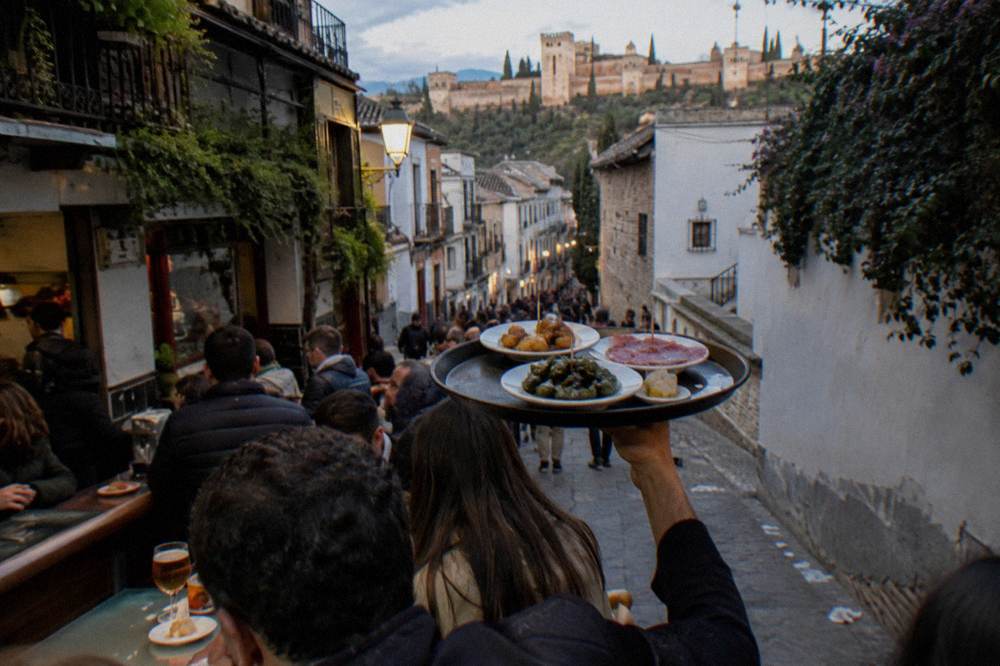
What can be tabulated honestly is the structure of the transaction: what you pay for, what arrives unbidden, and what never happens. The table below keeps those categories separate, and it is the same table you should keep in your head at the bar.
| Item | Do you pay? | How it works |
|---|---|---|
| The drink (beer, wine, soft drink) | Yes, at the bar's price | This is the entire basis of the custom; nothing arrives without it |
| The tapa that comes with it | No | Served with the paid drink; not billed, not ordered |
| A second round's tapa | No | In sequence bars, a different dish; in others, the same; in some, none |
| Food ordered from the menu | Yes, at menu price | A ración or full dish is a normal paid order, nothing to do with the custom |
| Tap water | The custom does not cover it | The gesture is described around paid drinks, not water |
| Table service versus standing at the bar | Either way the drink is paid | The custom is not formally tied to standing, though tabernas often serve at the bar |
The one trap worth naming here, because it costs real money, is confusing the free tapa with a paid ración. In Granada a ración is a full plate you order and pay for, and in many bars it is excellent value. But it is a purchase, and treating it as the free dish, or expecting the kitchen to keep sending free plates until you are full, is a misunderstanding of the custom rather than a dispute with the bar. The tapa is a small dish. It accompanies; it does not constitute dinner.
For contrast with the rest of the city's free side: the paid items in Granada that catch visitors out are elsewhere. The Alhambra's timed monument visit costs about EUR 22, the Cathedral is EUR 10 until 28 November 2026 and EUR 7 after, and the Junta-run museums charge EUR 1.50 to non-EU visitors. Against that backdrop the tapas custom is genuinely unusual: it is the city's only widely shared free-item tradition that operates with no ticket, no timeslot and no queue.
When Is The Best Time To Go For Tapas?
The custom runs all day whenever bars are open, but it is an evening habit at heart: the tapas streets fill from early evening as Granadinos finish work, and the sequence of tapas with each round is built around a slow, social few hours rather than a lunchtime stop. Bars set their own hours and no official schedule governs the custom, so no times are promised here.
That refusal to print hours is not evasion; there is genuinely no civic schedule to cite. Each bar opens and closes on its own rhythm, the streets as a whole wake up toward the evening, and the custom operates identically whenever the bar is pouring. What changes through the day is the character of the streets. A lunchtime circuit of Calle Navas is a quieter, faster affair; the same street later in the evening is standing room only, with plates moving along the counter.
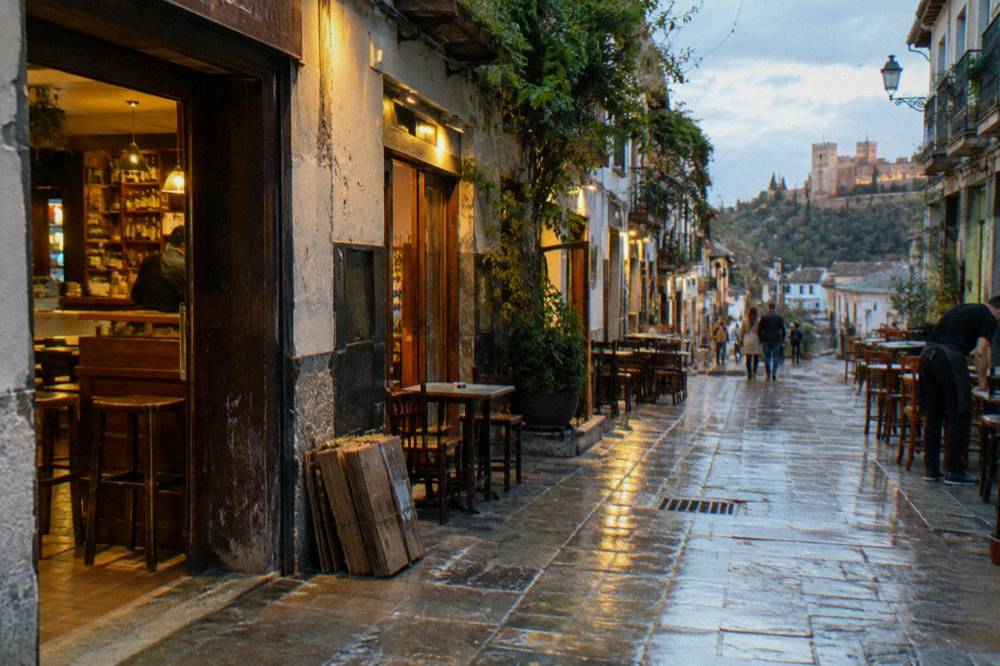
This is also where a free walking tour and the tapas custom meet most naturally, and it is the single best structural tip on this page. The centre walks run around two to two-and-a-half hours and finish in the late afternoon or early evening. Walk first, finish near your chosen street, and let the first round of drinks be the end of the tour and the start of the evening. Guides on these walks know the custom as well as anyone and, while this site names no bar, a guide you have just tipped is entitled to share a preference of their own.
The seasonal calendar barely touches the custom. Summer pushes the evening later, winter pulls it earlier, and the street festivals the city runs through the year, Semana Santa processions, Día de la Cruz in May, the Corpus season, fill the same streets with crowds but do not change the drink-plus-tapa mechanism. Rain is the only real disruption, because the classic tabernas are small and standing room is outdoors in all but name.
How Do You Combine Tapas With Other Free Sights?
Easily, because the tapas streets sit inside the densest cluster of genuinely free sights in the city: Calle Navas is a few minutes from Puerta Real and Plaza Bib-Rambla, Calle Elvira runs up toward Puerta de Elvira and the Albaicín, and the Realejo's Campo del Príncipe sits in a neighbourhood of free squares and street art. Every one of those places is free to be in, with no hours and no ticket.
The geography does most of the work. This is a compact centre, and the free sights chain together naturally. Plaza Bib-Rambla and the Alcaicería sit beside the Cathedral; Calle Navas begins a few blocks east; Gran Vía carries you to Calle Elvira and the Puerta de Elvira; through that gate the Albaicín climbs toward the Mirador de San Nicolás; and the Realejo spreads south of Plaza Nueva with Campo del Príncipe at its heart. None of that costs anything to walk.
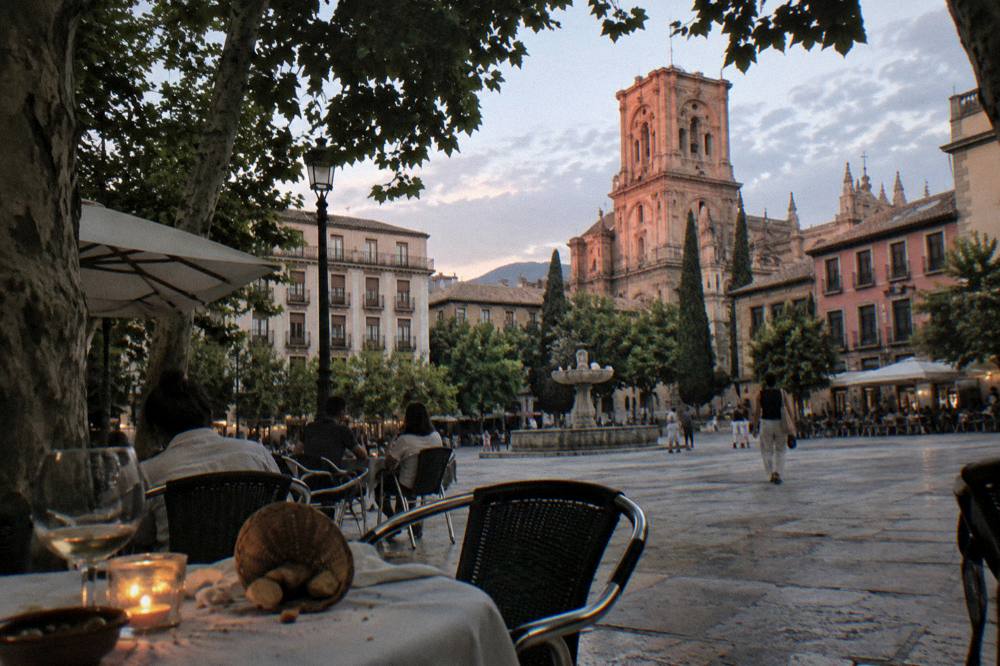
The honest way to plan it is to pick a tapas street first and hang the free sights on either side of it, rather than the reverse. A useful frame for the whole free side of the city is the site's free things to do in Granada overview, which keeps the free miradores and squares separate from the conditional and paid monuments. For the squares specifically, the Granada plazas and squares guide covers the free ones one by one.
| Tapas area | Free places on the doorstep |
|---|---|
| Calle Navas | Puerta Real, Plaza Bib-Rambla, the Alcaicería, the Cathedral exterior |
| Calle Elvira | Puerta de Elvira, Plaza Nueva, the lower Albaicín |
| Realejo, around Campo del Príncipe | The Realejo street art, Parque Federico García Lorca, Carmen de los Mártires gardens |
| Albaicín tavernas | Mirador de San Nicolás, Mirador de San Cristóbal, Carrera del Darro, Paseo de los Tristes |
A free tour is the natural hinge for an evening like this. Graná Highlights, Bilingual is a GuruWalk listing run by Granada Freetour, free and pay what you want, rated 4.5 out of 5 across 203 GuruWalk reviews, meeting at the Corral del Carbón on Calle Mariana Pineda and running about two hours in English and Spanish. That meeting point sits between Puerta Real and Calle Navas, so the walk finishes within a short stroll of the classic tapas street. For the deeper background on the pay-what-you-want model generally, see whether free walking tours in Granada are really free.
Which Free Walking Tours Meet Near Calle Navas?
Several of the city's pay what you want walks meet within a few minutes of the tapas streets, on Plaza Nueva, at the Sagrario Church beside the Cathedral, and at Plaza de Bib-Rambla. All are free to reserve with a tip at the end, most run in English as well as Spanish, and each finishes in the early evening in the right place to start the tapas round.
The listing with the largest review pool in the entire directory is Walk in Granada: Essential, listed on freetour.com, rated 9.4 out of 10 with its 5,237 reviews shown on its freetour.com listing, meeting at Plaza Nueva and running two and a half hours in English and Spanish. Plaza Nueva is the hinge between Gran Vía, Calle Elvira and the Albaicín, which puts the end of that walk within easy reach of both of the big tapas streets. This site runs none of the walks; links to GuruWalk and freetour.com carry its referral code, and every walk is an independent local guide.
Fall in Love Walk, English is a GuruWalk listing by the guide Marta, rated 4.92 out of 5 across 573 GuruWalk reviews, meeting at Puerta de Elvira by Plaza del Triunfo and running about two hours in English. Puerta de Elvira is the bottom of Calle Elvira, so this one finishes essentially at the top of a tapas street. Between them, these walks bracket the whole free-sight cluster described above, and none of them charges anything up front.
| Walk | Platform and guide | Meets at | Language |
|---|---|---|---|
| Walk in Granada: Essential | freetour.com, Walk in Granada Tours | Plaza Nueva | English and Spanish |
| Fall in Love Walk, English | GuruWalk, Marta | Puerta de Elvira, Plaza del Triunfo | English |
| Graná Highlights, Bilingual | GuruWalk, Granada Freetour | Corral del Carbón, Calle Mariana Pineda | English and Spanish |
| Center, Albaicín and Sacromonte | GuruWalk, Marta | Sagrario Church, next to the Cathedral | English and Spanish |
The meeting points above are written exactly as each listing gives them. The full directory of the city's free, pay what you want walks, with every rating and platform stated, is in the free walking tours in Granada guide, and the question of how much to tip at the end of one is covered separately in how much to tip on a free tour in Granada.
Mistakes That Trip People Up At Free Tapas In Granada
The recurring mistakes are all versions of overclaiming: expecting food without buying a drink, assuming every bar participates, treating the custom as a legal right, budgeting as if the food were a meal, and confusing the free tapa with menu dishes that are sold normally. Each mistake comes from reading "free tapas" as a promise rather than a custom, and each is avoidable with the one-rule framing of this guide.
The drinkless expectation is the commonest. A group sits down, orders nothing or orders water, and waits for the plates. The custom is built on a paid drink; without one there is no tapa to be had, and no argument to make. Related is the assumption of universality: a bar that serves no tapa is not cheating you, it is simply outside the tradition, and the variation from bar to bar is the defining feature, not a defect.

The budgeting mistake follows. Some visitors plan an evening assuming the tapas will substitute for dinner. Sometimes they nearly do, in a sequence bar over several rounds. But the dish is small by design, its size is the bar's choice, and an evening built on the assumption of a free feast ends in a late paid ración. The mirror-image mistake is ignoring the custom's real value: a few rounds of drinks with a dish each is one of the better-value evenings in a city whose headline monument costs about EUR 22 to enter.
The last mistakes are borrowed from the rest of the free side of the city, and they are the ones this site exists to correct. Visitors read "free tapas" and then assume everything nearby is free too: that the Alhambra can be walked into (it cannot, the monument is paid and timed, though the hill has free parts including the Palacio de Carlos V and the Museo de la Alhambra, per the Patronato's official hours and prices page), or that the Cathedral is free to visit (it is EUR 10 until 28 November 2026, then EUR 7, free on Tuesday only for residents of Granada province). Keeping the regimes separate, bar custom from monument ticket, is what turns a cheap evening into a correctly planned one.
Common Questions About Free Tapas In Granada
Is Tapas In Granada Really Free?
The tapa is free and the drink is not. In bars that keep the custom, a small plate of food arrives with the beer, wine or soft drink you order and pay for, and the plate itself is never billed. It is a bar custom that varies from bar to bar, not a rule or a legal right, and no official body guarantees it anywhere.
What Does The Free Tapa Actually Come With?
It comes with a paid drink: beer, wine or a soft drink. It does not come with tap water, it is not served on its own to someone who orders nothing, and it is not a discount on food ordered from the menu. A full dish from the menu is a normal paid order with nothing free attached.
What Costs Money When You Order Tapas?
The drinks, at whatever price the bar sets, plus anything you order from the menu. The tapa never appears on the bill. That means drink prices and the number of rounds set the cost of your evening, and the food side of it is effectively included in the room.
When Is The Best Time To Go For Tapas?
The custom operates whenever a participating bar is open, but it is an evening habit: the tapas streets fill from early evening as locals finish work. Bars set their own hours and no official schedule governs the custom, so no specific times are promised here, and the character of the streets changes more than the mechanism does.
Where Is The Tapas Custom Strongest?
The streets most associated with the custom are Calle Navas, Calle Elvira, the Realejo around Campo del Príncipe, and the Albaicín. Each is a free public street you can walk at any time, and each is surrounded by free sights: plazas, miradores and historic lanes that need no ticket.
Can You Combine Tapas With A Free Walking Tour?
Yes, and it is the natural pairing. Free, pay what you want walks on GuruWalk and freetour.com finish in the early evening at meeting points such as Plaza Nueva, Puerta de Elvira and the Corral del Carbón, each within a short stroll of a tapas street. You tip the guide what you choose and then start the rounds.